
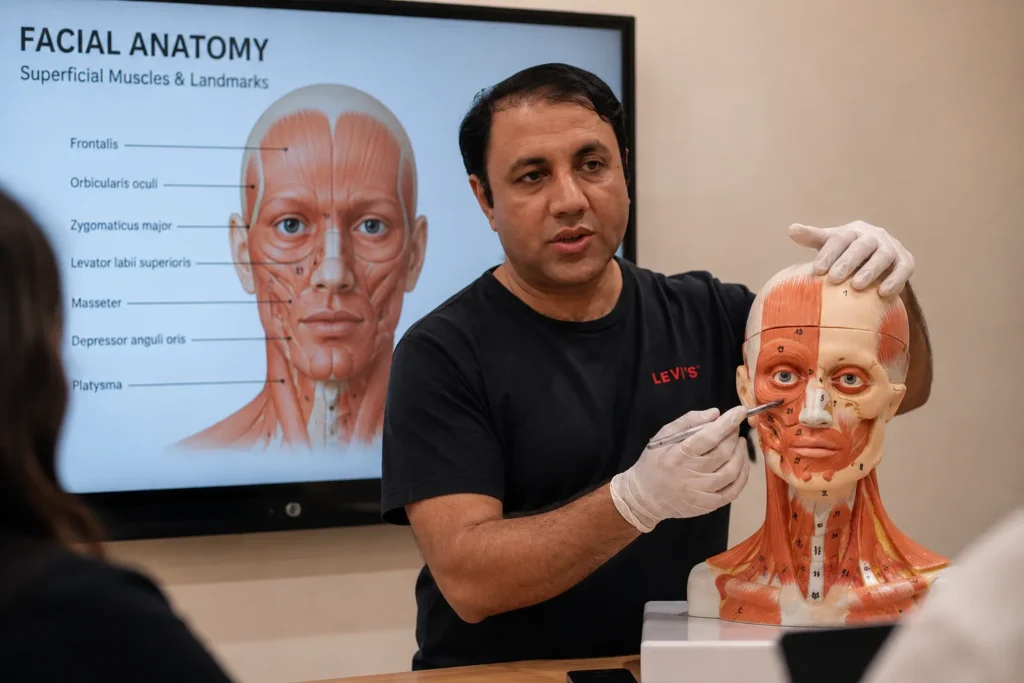
Many MBBS doctors in Pakistan ask the same question at the start of their aesthetic journey: where should I begin, and in what order? The field is visible everywhere, from social media results to clinic advertisements, and it is easy to assume that learning a procedure is the same as learning aesthetic medicine. In practice, safe and credible aesthetic practice is built in layers. Anatomy comes before injection technique, assessment comes before treatment selection, and consultation skills come before any plan is offered to a patient.
This guide is written for doctors and healthcare professionals who are exploring aesthetic medicine training in Pakistan. It explains the foundations that matter most, what a good foundation course should cover, the mistakes that commonly slow beginners down, and a sensible pathway from foundation learning to advanced work and, later, to a broader longevity perspective. It is general educational information, not a substitute for individual clinical judgement or for supervised, hands-on training where that is required.
If you are considering this field, the most useful question is not simply which treatment is popular this year. It is: do I understand the face, the skin, the patient in front of me, and the limits of what I can safely offer? When those foundations are strong, later learning becomes faster, safer and more satisfying.
Why doctors are adding aesthetics — and why order matters
Doctors are drawn to aesthetic medicine for different reasons. Some enjoy the combination of clinical assessment, visual judgement and practical skill. Others see patients who ask about skin, ageing and confidence and want to answer those questions with evidence rather than guesswork. Many also value a field where careful consultation, prevention and long-term planning matter as much as a single appointment.
Order matters because aesthetic medicine rewards sequence. A doctor who understands facial anatomy, skin types, ageing changes and medical history can make better decisions about who is suitable for a treatment, who needs a different approach, and who should be referred or advised to wait. A doctor who starts with advanced techniques before that foundation is in place may learn movements without learning judgement, and judgement is what protects patients when a case is unusual, complex or not straightforward.
Order also matters for professional credibility. Patients notice when a doctor listens, explains options honestly, discusses benefits and limitations, and does not promise a specific outcome. Colleagues notice it too. A structured start builds a reputation for careful practice, while a rushed start can create problems that take much longer to undo.
- Start with assessment, anatomy and consultation, not with a single popular procedure.
- Learn to recognise when not to treat, or when to seek further advice, as early as you learn when to treat.
- Build confidence through case discussion, not only through watching demonstrations.
- Keep notes, reflect on cases, and revisit foundations as your experience grows.
The foundations first: facial anatomy, skin assessment and consultation
Facial anatomy is the foundation that makes every other topic safer. The face is not a flat surface. It has layers, muscles, fat compartments, blood vessels and nerves, and these structures vary between people and change with age. A doctor who can picture what lies beneath the skin is better placed to assess risk, explain choices, and recognise when a presentation needs a different plan. Anatomy teaching should be revisited regularly, not treated as a single early lecture that is then forgotten.
Skin assessment is equally central. It includes skin type and tone, texture, pigmentation, sun exposure, previous treatments, healing tendencies and the patient’s own concerns and priorities. In Pakistan, where many patients have darker skin tones and strong sun exposure, assessment must also consider pigmentation risk, sensitivity and the way skin responds to irritation or inflammation. A careful assessment helps the doctor set realistic expectations and choose a gentler, more suitable approach where needed.
Consultation brings anatomy and assessment together. A good consultation explores medical history, current medicines and health conditions in general terms, allergies and previous reactions, lifestyle factors such as sun exposure and smoking, and what the patient hopes to achieve. It also creates space for the patient to ask questions and to hear, in plain language, the benefits, limitations, possible complications and alternatives. Documentation of that discussion protects both patient and doctor and supports continuity of care.
What a good foundation course should cover (and what to ask before enrolling)
A good foundation course should teach principles before products. Look for structured teaching on facial anatomy, skin assessment, consultation and consent, common conditions at a general level, treatment planning, safety and complication recognition, documentation and follow-up, and ethical practice. Live online learning with clinical case discussion is especially valuable, because cases show how principles are applied when information is incomplete or when a patient has more than one concern.
Before enrolling, ask practical questions. Who teaches the course, and what is their clinical and teaching experience? Is the teaching live and interactive, or only recorded? Are cases discussed, with time for questions? Does the course explain safety, assessment and when to refer, rather than focusing only on technique? Is there guidance on building a practice ethically, including consultation and record-keeping? Clear answers to those questions are a good sign. Vague promises, or a focus only on quick results, are a warning sign.
Also consider how learning will fit your working life. Live online teaching can suit doctors in different cities, but it still requires time for study, reflection and case review. A course that encourages questions, discussion and follow-up learning is more useful than one that simply delivers information.
Common beginner mistakes: skipping assessment, copying trends, and rushing to advanced injectables
Three mistakes appear again and again in early aesthetic practice. The first is skipping assessment. When consultation is rushed, important history, skin factors and patient expectations may be missed, and a plan may be chosen for the wrong reason. A short assessment at the start often saves a long problem later.
The second is copying trends. A result seen online may suit one face, one skin type and one set of circumstances, but not another. Trends also change quickly, while anatomy and safety principles change slowly. Doctors should ask why a treatment is suitable for this patient, not only whether it is popular.
The third is rushing to advanced injectables before foundations are secure. Advanced work requires a deeper understanding of anatomy, assessment, risk and complication recognition. Moving too fast can increase risk and reduce confidence. It is better to be thorough at foundation level, seek case discussion, and progress when assessment and safety skills are reliable.
| Approach | What it looks like | Why it matters |
|---|---|---|
| Foundation-first | Anatomy, assessment, consultation, then technique | Safer decisions and clearer expectations |
| Trend-first | Copying a popular result without full assessment | Higher risk of unsuitable plans and disappointment |
| Technique-only | Learning movements without safety and follow-up | Weak recognition of complications and limits |
A sensible learning pathway: foundation, then advanced, then longevity
A sensible pathway begins with a foundation course that covers facial anatomy, skin assessment, consultation, safety and basic aesthetic principles. At this stage, the aim is not to know everything, but to know how to assess, plan, communicate and recognise when to pause or refer. Case discussion helps turn theory into judgement.
The next stage is advanced learning, where doctors deepen procedural understanding, complication management and treatment planning for more complex cases. This stage builds on foundation skills, rather than replacing them. Doctors who progress in this order often find advanced topics easier, because they already have a framework for assessment and safety.
Later, many doctors explore longevity medicine, which looks at how internal health, including hormonal health, metabolism, inflammation, sleep, nutrition and activity, can influence skin, volume, healing and overall aesthetic outcomes. This broader view does not replace aesthetic foundations. It extends them, helping doctors plan care that considers both surface appearance and underlying health at a general level.
Throughout the pathway, keep learning. Review cases, update anatomy knowledge, discuss difficult presentations with experienced colleagues, and remain honest about your current scope. Good practice is a habit, not a certificate earned once.
FAQs
Do I need to be an MBBS doctor to start learning aesthetic medicine? RALM Academy courses are designed for MBBS doctors and healthcare professionals. If you are unsure whether a course suits your background, it is best to ask the academy before enrolling, so you can choose the right starting point.
What should I learn first? Start with facial anatomy, skin assessment, consultation, consent and safety. These foundations support every later topic and help you make safer, more confident decisions.
Is live online learning enough for foundation training? Live online learning with clinical case discussion can build strong assessment, planning and safety knowledge. It also helps doctors in different cities learn together. Where practical skills require supervised practice, follow the course guidance and your local professional requirements.
How do I choose between a foundation course and a short masterclass? A foundation course gives a broad, structured starting point. A short masterclass focuses on one topic in depth. Many doctors benefit from a foundation first, then masterclasses in topics they wish to explore further.
What if a patient asks for a treatment I do not think is suitable? Explain your assessment in plain language, discuss benefits, limitations and alternatives, and do not promise a specific outcome. Where appropriate, advise waiting, suggest a different plan, or refer for further advice. Clear, kind honesty builds trust.
How can I keep improving after a foundation course? Keep reviewing cases, revisit anatomy and safety topics, take part in case discussions, and progress to advanced learning only when your foundation skills are reliable. Reflective, ongoing learning matters more than speed.
Start with a strong foundation
If you are ready to build aesthetic medicine skills in the right order, explore the Aesthetic Medicine Level 1 course at RALM Academy, which focuses on foundations, assessment and practical confidence for doctors and healthcare professionals. For enrolment enquiries, call +92 311 6755667. A structured start will serve you, and your patients, for years to come.
Disclaimer: This post provides general educational information for healthcare professionals. It is not medical advice and is not a substitute for individual clinical judgement.